
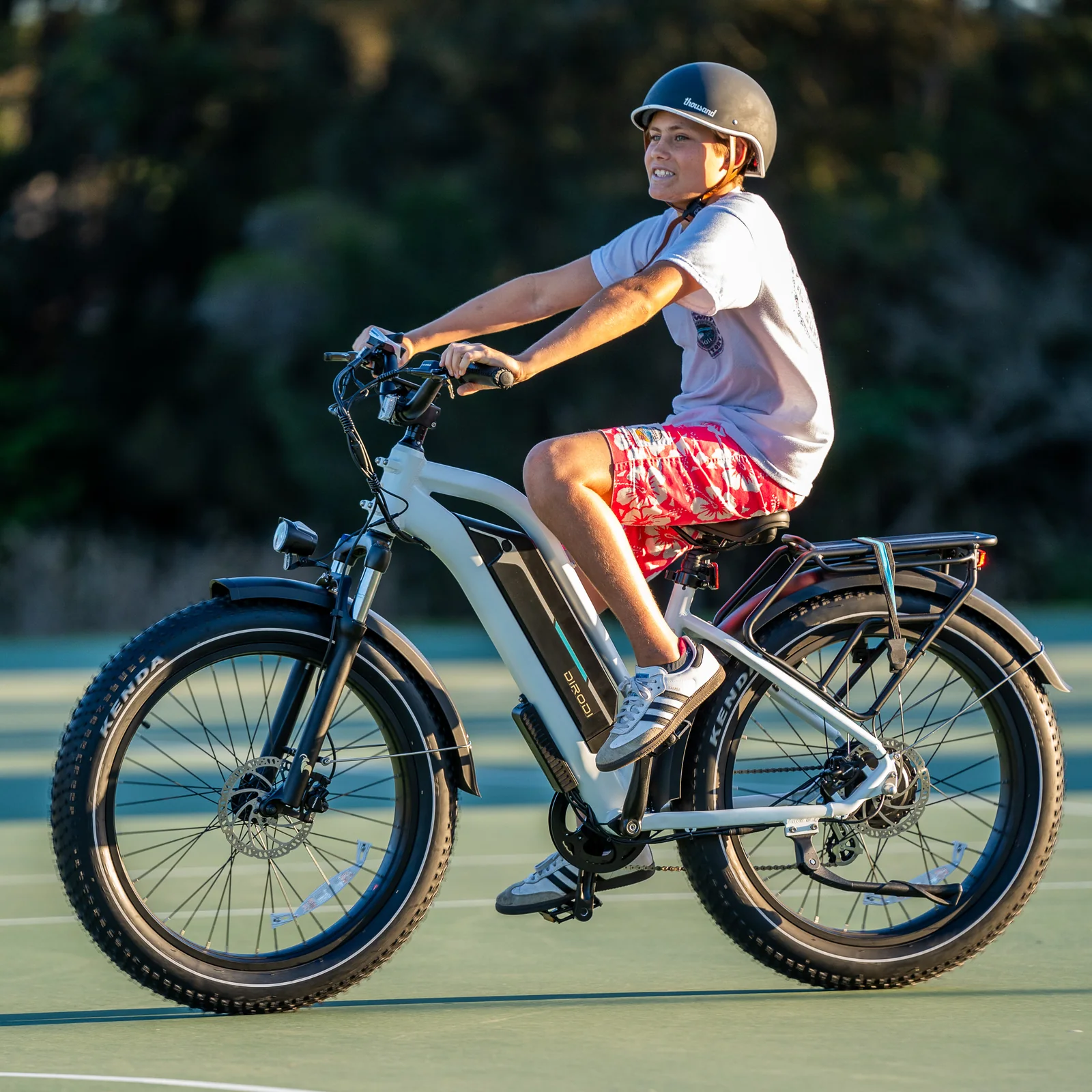
The DiroDi Vivo combines fat tyres with a conventional bicycle saddle that you can adjust in height. That makes it worth trying if you like wide tyres but prefer a different seat from the Rover's long bench.
Here is what those features mean when you ride, park and look after the bike.
Explore the DiroDi Vivo and confirm the equipment and battery options for your selected generation and variant.
DiroDi Vivo features at a glance
| Published Vivo feature | Why it is worth checking |
|---|---|
| 20 x 4.0-inch Kenda tyres | Tyre volume and width differ substantially from a narrower commuter setup |
| Conventional adjustable saddle | Lets you alter saddle height within the permitted seatpost limits |
| Tektro E-350 hydraulic brakes | Check lever fit and braking feel on the actual bike |
| 180mm brake rotors | Identify the correct replacement parts and servicing requirements |
| Removable battery options | Compare the capacity supplied, removal procedure and charging access |
| Colour display | Learn the assistance, trip and battery information before a longer journey |
Use the feature list to decide what to try. Check brake-lever reach, riding position and low-speed handling on the actual bike. Confirm the battery and equipment included in your chosen version.
For more detail, see fat tyre electric bikes.
Check tyre pressure for your load
Tyre pressure affects comfort and handling. Use a gauge and follow the tyre, rim and bike instructions for your load. Too little pressure can make the bike hard to control or damage the tyre and rim. Too much can make bumps feel harsher.
Avoid the idea that the same pressure is correct for a solo weekday ride and a heavily loaded trip. Also avoid assuming that every fat tyre behaves the same: tread, casing and surface affect how a tyre rolls and grips. Schwalbe's tyre-pressure explanation sets out why load and pressure need to be considered together.
Puncture-resistant construction does not make a tyre puncture-proof. Learn the tyre and tube size, check for embedded debris and have a plan for a flat. With a rear hub motor, wheel removal involves more than treating the bike as a simple unpowered wheel: follow the correct model procedure or use a workshop.
Check the whole bike's size and weight
The 20-inch designation describes the wheel format, not the overall length, width or lifting weight of the finished bike. Wide tyres, wheelbase, handlebar width and accessories still determine whether it fits your storage space or carrier.
Measure the path from the street to the parking spot, including tight turns and the width of any lift door. If the bike must travel on a car, confirm the exact carrier's weight limit, tyre accommodation, wheelbase limit and attachment method. See our e-bike transport guide before buying a carrier based only on wheel size.
Adjust the saddle for comfortable pedalling
Vivo's conventional seatpost makes it worth comparing with Rover if saddle-height adjustment is important to you. Make adjustments only within the marked limits and follow the specified clamping instructions. A workshop can help establish a comfortable starting position.
During a test ride, check a full pedal rotation, low-speed turning and starts from a stop. Notice whether you can operate the brake levers comfortably without stretching. Test with low assistance first so you understand the bicycle's fit and balance rather than relying on the motor to conceal an awkward position.
If getting a leg across the bike is your main concern, also compare the Primo's step-through layout and any available Vivo frame option. Look at the actual frame opening and fitted accessories rather than treating a label as a guarantee of easy access.
For more detail, see step-through vs standard frames.
Check which battery is included
Vivo's product information describes alternative battery capacities. Ask which one is supplied with the exact option you select and whether any future upgrade requires an approved battery or mounting arrangement. A connector that physically fits does not prove electrical compatibility.
For a useful range assessment, provide DiroDi with the return-trip distance, hills, rider and luggage load, assistance preference and charging opportunities. Treat published maximum distances as conditional figures, not a promise for every route. Our battery comparison explains why watt-hours provide a better capacity comparison than voltage alone.
Choose a charging location before delivery. The battery should be charged using the specified charger and the manufacturer's procedure, with supervision and appropriate clearance from exits and combustible items. The NSW Government battery-safety guide provides the safety background.
Choose the version for where you will ride
Select a variant that qualifies for the places you intend to ride. Power limits, assistance behaviour and compliance requirements cannot be established from styling or from the bike being sold in Australia. Ask for the exact configuration and compare it with your state government's current requirements.
This also means a private-land power option should not be marketed as interchangeable with a public-road variant merely because a lower display setting is available. Choose the intended use first, then the bike configuration.
What to try on a Vivo test ride
Bring your normal footwear and a realistic idea of your luggage. Check saddle adjustment, low-speed control, a gentle incline, a controlled stop and the final parking manoeuvre. Afterwards, compare those observations with Primo and Rover using our range comparison guide.
Vivo is a sensible shortlist candidate when the fat-tyre format appeals and you want a conventional adjustable saddle. The decision should turn on those practical differences, not an unsupported promise that one bike is best for everyone.
For more detail, see DiroDi rider stories.
Frequently asked questions
What tyre pressure should I use on a DiroDi Vivo?
Use the guidance for the exact tyre, rim, model and rider load, staying within all permitted limits. Do not copy a pressure from a different bike simply because it also has fat tyres. Check pressure regularly with a suitable gauge and ask the retailer if the correct range is unclear.
What rider height suits the DiroDi Vivo?
Check the current size guidance and try the bike rather than relying on a single height number. Saddle adjustment, leg length, reach and confidence at stops all matter. Confirm the seatpost adjustment limits, then test starting, stopping, walking the bike and a comfortable pedalling position before deciding.
How is the Vivo different from a Rover?
Vivo combines fat tyres with a conventional adjustable saddle, while the Rover family uses a long bench-seat layout. That changes the riding position and how you adjust the fit. Compare the exact models, suspension, carrying arrangements and storage footprint on a test ride instead of choosing from tyre width alone.
DiroDi Vivo: Fat Tyres and an Adjustable Saddle